~/writingblack-friday-email-signature-sale-tracking
A Black Friday email signature sale, tracked from ad to revenue
Simple Email Signature's Black Friday sale is live at 20% off the first year, with posts, Meta ads and Stripe revenue tracked in one Google Sheet.

Simple Email Signature has a Black Friday sale running now through November 30: 20% off the first year of any paid plan. The discount comes off at checkout with no code, and the plan renews at its regular price. Solo, with one signature, is $31.20 for the first year instead of $39. Team, with five, is $95.20 instead of $119.
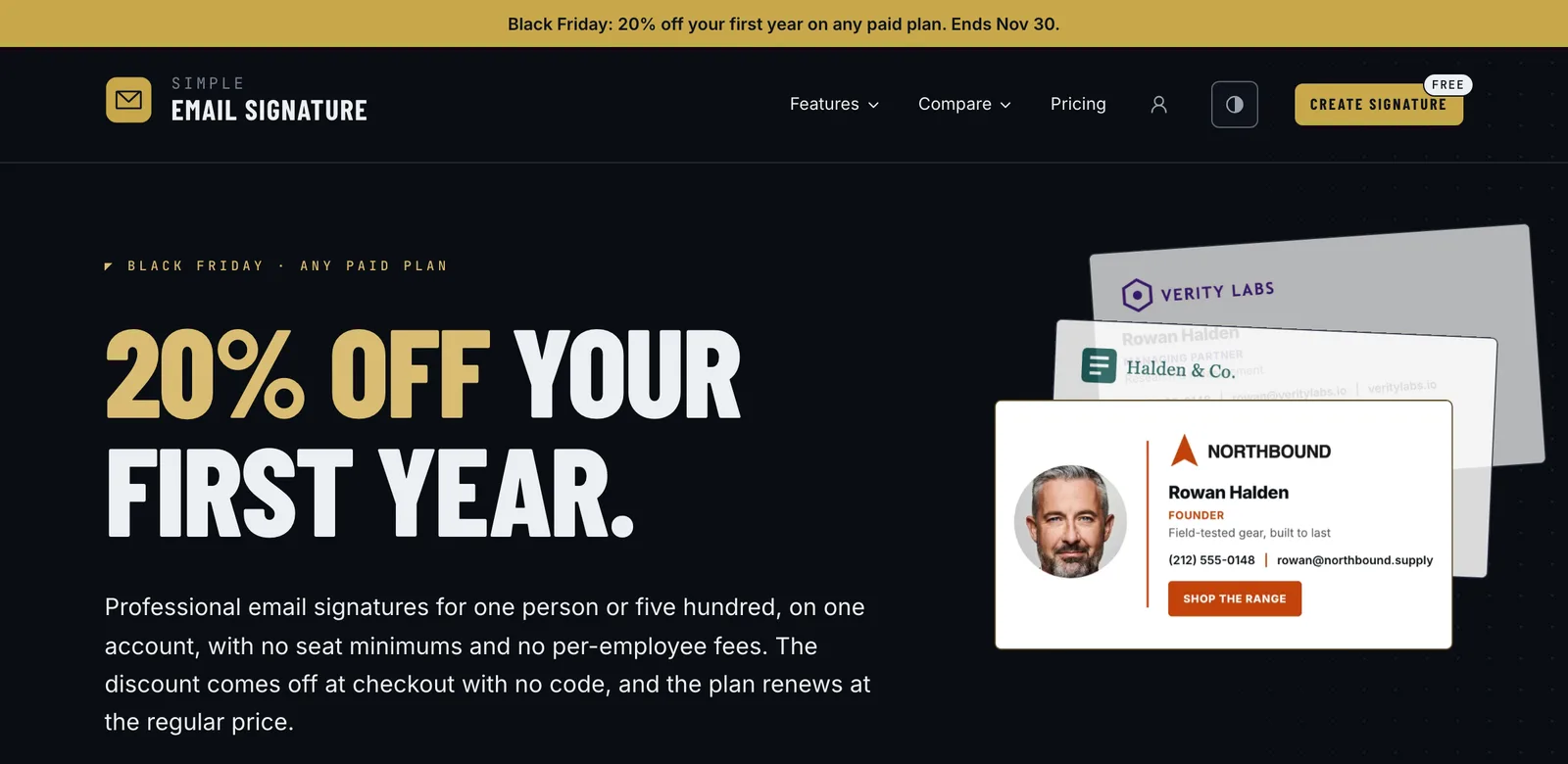
The page has a reminder form for anyone who wants to come back later. It signs them up for up to five emails: November 16, November 23, Black Friday, and two on the last day. Each one checks who it's going to when it sends, so anyone who has bought by then drops out on their own.
I ran test copies of all five and read them in light and dark mode, and Stripe's real payment page shows Solo at $31.20, then $39 a year. If Stripe ever refuses the discount, checkout falls back to full price and emails support, so a problem with the promotion can't stop a sale. Not measured yet: a real purchase at the sale price.
A scoreboard for the sale
I'm getting ready to run Meta ads for this sale, so I set up the tracking first: a UTM campaign sheet in Google Sheets, built with the Campaign Tracker Pack from Heavy Artillery Skills. Each post or ad gets its own short link, which carries its tags to the sale page.
The sheet will show me which pieces of content work, both as organic posts and as paid ads. For the paid ads, it will show what each lead cost and what it cost to acquire a customer. Revenue tracking comes in through Stripe, so sales sit in the same sheet as visits and leads. That makes it a scoreboard for how organic and paid are each doing on this promotion.
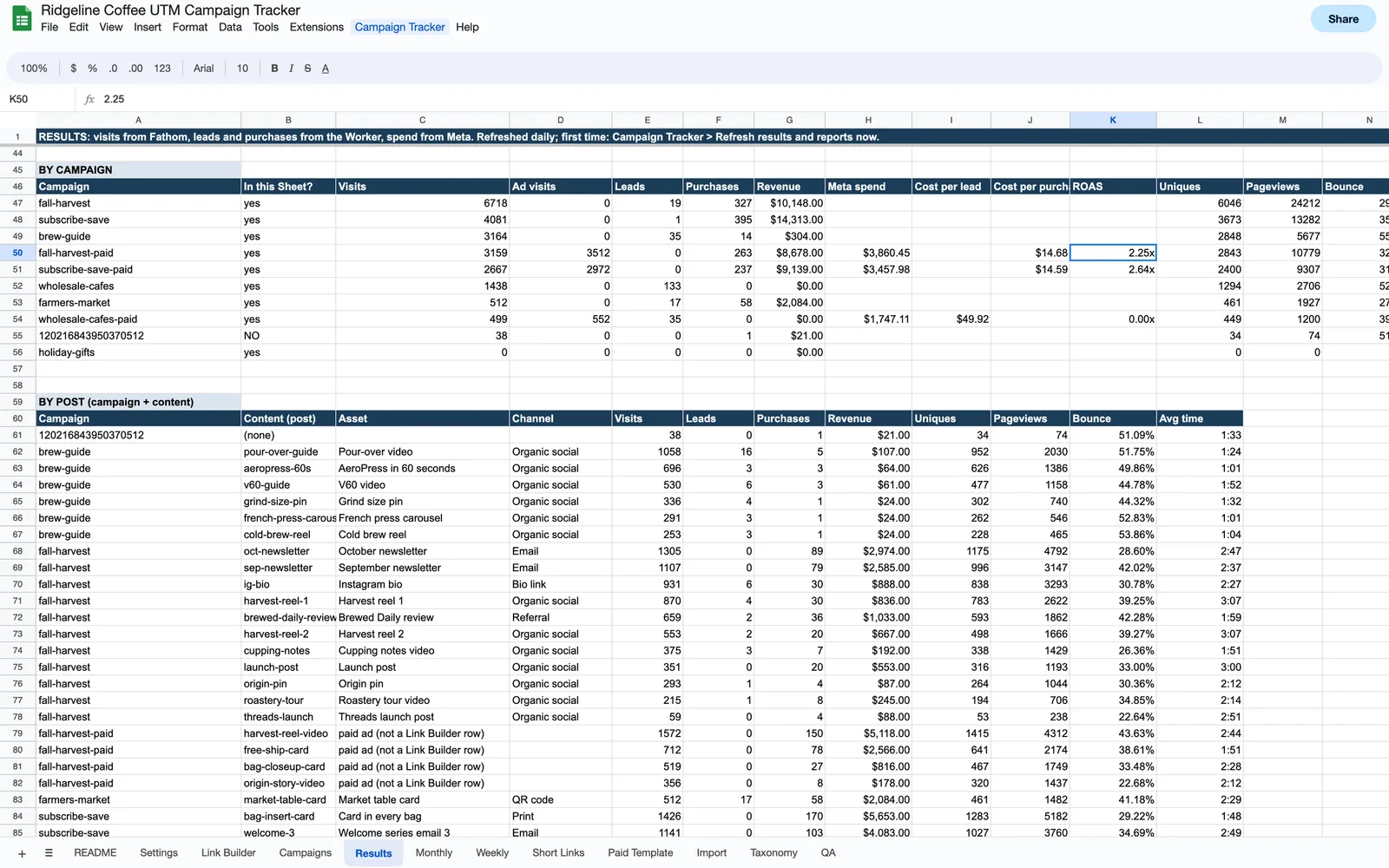
Those are the pack's sample numbers for a made-up coffee roaster, not mine. The ads aren't running yet.
A lead capture funnel you can try
The Speed to Lead demo on Matchless Web now has all of its moving parts configured, including a new Twilio text campaign. It shows how you can set up a lead capture funnel for the moments you can't answer right away: someone submits the contact form on your site while you're on a job, and you can't check your email or reply.
The demo plays out as a sample HVAC request. The first text arrives within seconds. About a minute later, a second text carries a link to book a call through Calendly, and a reply or a booking stops the reminders. In the demo, that link books a real 15-minute call with me. In your line of work, it could be a service call or an in-person meeting.
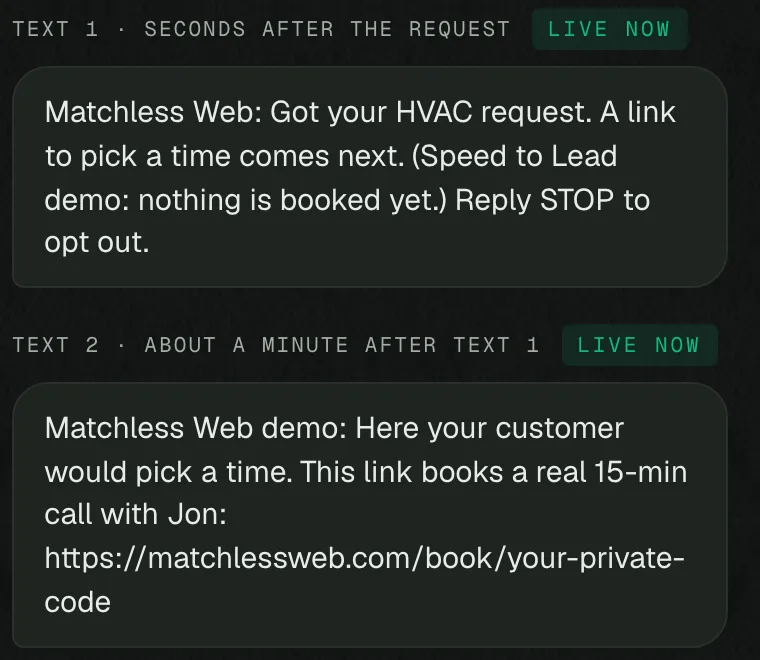
The texts and emails are optional on the demo form. You can also read every text and email, seven of each over seven days, with a map of what starts and stops each one.
A publishing routine that kept stopping
The Codex cloud routine that publishes articles for BTC DCA Engine was hitting too many failure points. Its job is to run an article through the Blind Panel critic loop, review it for accuracy, and reach a stage where I can read it and publish it. It wasn't finishing that job.
So on October 28 I had Codex switch to a Blind Panel writing workflow closer to the one Matchless Web uses, while keeping what was working well. A draft-only run writes and reviews the article without being able to publish it, and the reviewed draft goes out through a separate step. The first one out is Bitcoin Purchasing Power: DCA Returns After CPI. Some of the job runs in the cloud and doesn't need my computer awake or online. Other parts need my computer.
The two still differ. On both, critics compare the article with two rival pages and a planted decoy without knowing which is which. On Matchless Web, a scheduled Claude session drafts the post on a branch and runs the panel, then a session on my computer lays out the post's one-page PDF and captures screenshots from my own accounts. BTC DCA Engine's cloud side is ordinary GitHub Actions code started by a Cloudflare timer, calling paid models under a spending cap for each article. A failed paid stage stops and waits for me instead of retrying.
Recent posts on the Matchless Web homepage
The Matchless Web blog is filling up now that I've settled into two posts a week, on Mondays and Thursdays, so I put its three newest posts in a section near the bottom of the homepage. Until now the footer was the only place it was linked, because it isn't in the header navigation.
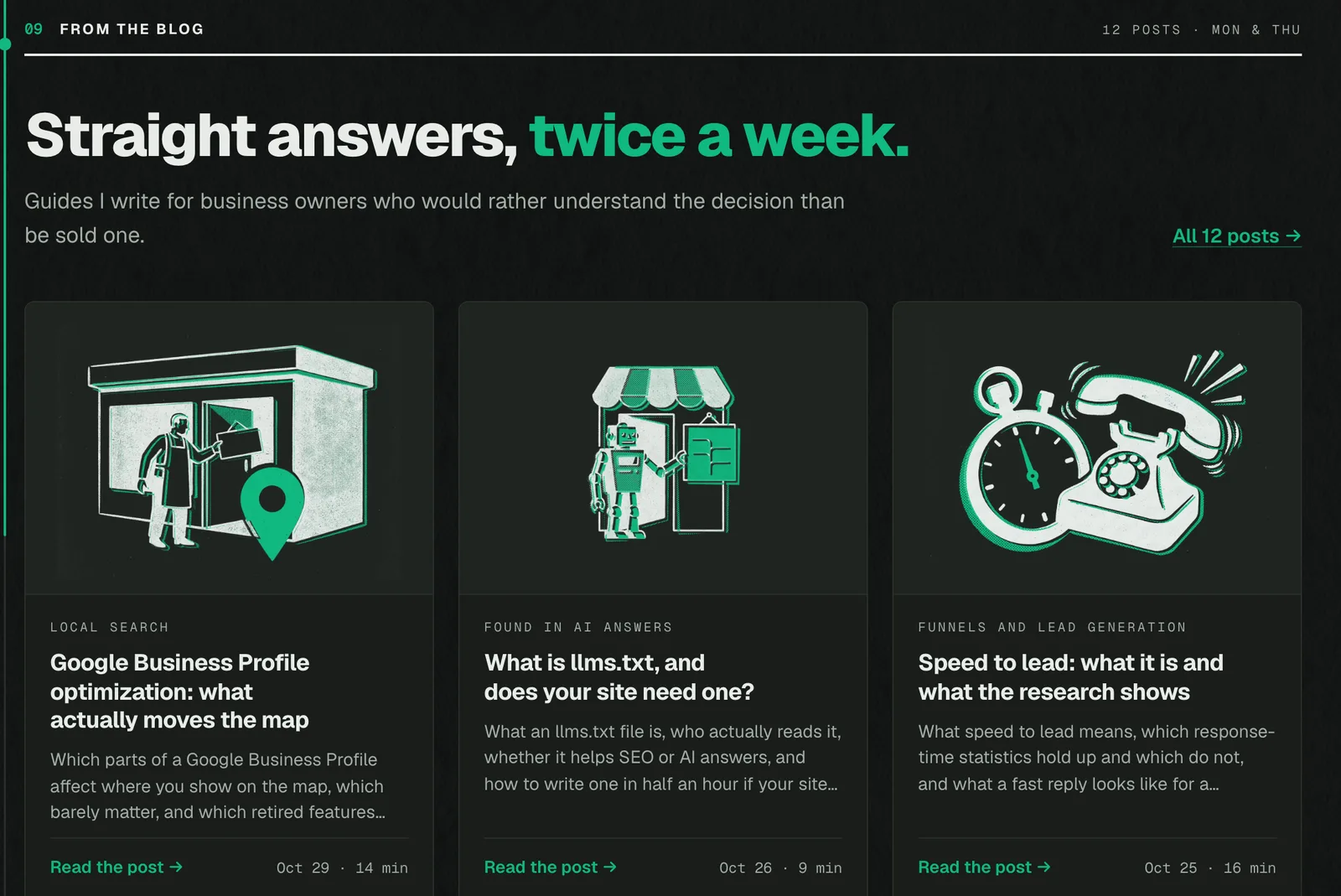
Showing there now: Google Business Profile optimization, what llms.txt is and speed to lead. 8G Helper, the free firewall helper from last week, also has its own case study there now.
Two launches ahead
At the top of next week, I'm preparing to launch a site for a rural medical clinic. I'm also very close on a site for a rural hospital, though that one may still be a few weeks from officially launching.

Jon Phillips builds websites, web apps and automations at Matchless Web in Clinton, Mississippi.